The Operating Model Behind Stable Fintech Programs
Contents
Maintaining Delivery Discipline in Live Operations
Launch is often mistaken for a finish line, but in reality, it is merely a change in the state of the program. During the implementation phase, teams can afford to treat the stack as a series of isolated workstreams with their own deadlines and vendor boundaries. Production removes this luxury. Once a service is live, customers transact in real time, support teams inherit immediate cases, and compliance officers begin judging the actual behavior of the system rather than its theoretical design.
In this live environment, the stakes are significantly higher. Small technical defects that seemed minor during development now carry immediate consequences for a running service. A neat handover on paper often fails to survive the friction of reality, especially in multi vendor programs. When one provider owns the mobile app, another the payment rails, and a third the compliance screening, the operational burden of a cross system failure falls squarely on the institution.
If the delivery team steps back too sharply at this stage, critical knowledge evaporates. Open assumptions remain unresolved, and responsibility becomes impossible to pin down. Post launch stability depends on continuity. Implementation may technically end, but delivery discipline must remain.

The Pillars of a Stable Operating Model
A stable operating environment starts with clear maintenance ownership. In a fragmented stack, someone must be accountable for the entire service map. This requires an understanding of which vendor owns which layer, how incidents move across those interfaces, and who has the authority to close a problem rather than simply reporting it. Without this central logic, live support quickly degrades into a routing exercise where teams spend more time assigning blame than fixing the issue.
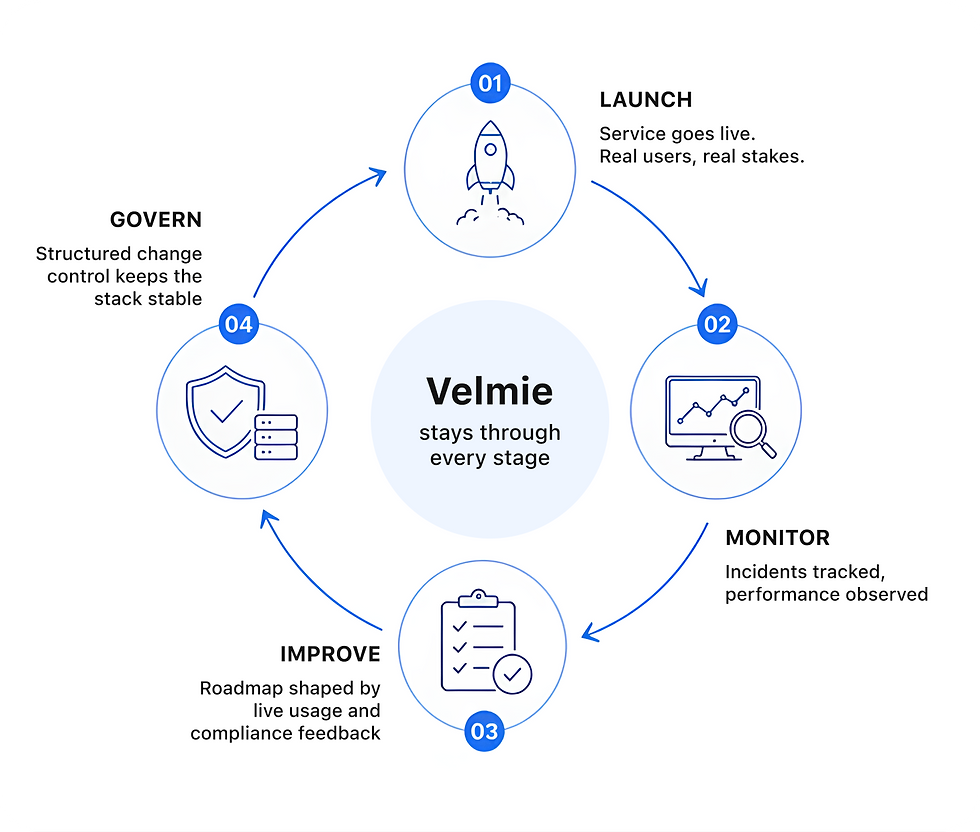
Incident response is only the most visible part of the model. Release governance is equally critical because a regulated stack never stops changing after it hits the market. Upgrade planning, performance monitoring, and reliability tracking must sit close to the delivery ownership.
A strong model makes live operations legible. It allows teams to see exactly what changed, why a specific component failed, and what the next step must be. Conversely, a weak model leads to escalation drift. More time is wasted on coordination and interpretation, leaving the service vulnerable to the compounding effects of unresolved issues.

The Reality of Continuous Improvement
Go live does not close the roadmap. It simply changes the conditions under which the roadmap must move. In many ways, backlog management becomes more important after launch because the priorities are now driven by real usage rather than pre launch hypotheses.
Customer behavior reveals where journeys still create friction. Operational teams surface edge cases that were never anticipated during design workshops. Compliance teams demand adjustments once they have observed the live service in action. These lessons are the most valuable data an organization can possess, but acting on them requires a high degree of discipline.
A regulated stack cannot absorb improvements through intuition. Enhancing the service without destabilizing core flows or weakening controls requires a structured approach. Institutions that keep their roadmap closely aligned with their operational reality are able to improve faster while breaking less.
Common Failures in Post-Launch Programs
The first thing to weaken in many post launch environments is the ownership of vendor issues. When a problem crosses two or three providers and each team sees only a fragment of the failure, the institution often gets stuck in a loop of inconclusive diagnostic reports.
Formal change control is another frequent casualty. Changes often begin to happen through a sense of urgency, relying on exceptions and local workarounds rather than a production grade model. This lack of structure leads to a loss of visibility. Operational teams may find they no longer see enough of the system to explain a failure to a customer, making support slower and incident handling more expensive.
Engineering teams often compensate for these weaknesses with ad hoc fixes. While these appear faster in the short term, they lead to an accumulation of technical debt. The program rarely collapses overnight, but it becomes harder to trust. Release confidence falls, and the predictability of the service begins to erode.

Redefining the Role of a Delivery Partner
A long term delivery partner should contribute ongoing accountability, not just a historical record of the build. Institutions need a support model that remains structured long after the initial launch party is over. This means defined escalation paths and a controlled approach to upgrades and routine maintenance.
Capacity is also a vital consideration. A successful stack will inevitably attract new requirements. New integrations will be needed, compliance expectations will shift, and product teams will ask for refinements that were not prioritized six months earlier. A credible partner needs enough operational depth to absorb this evolution without forcing the institution into a completely new implementation cycle every time the service matures.
The real test of a partner is not whether they can build the stack, but whether they can keep it reliable while it continues to change under the pressure of a live market.
The Commercial Value of Stability
A robust post launch model reduces disruption because it allows teams to resolve incidents and ship changes within a structure that already exists. This reduces the confusion around ownership and sequencing that often plagues maturing fintech programs.
Predictability improves when delivery stops depending on individual memory or informal escalations. When the roadmap is shaped around what the live environment can actually absorb, the institution gains a steadier route to enhancement and lower operational friction.
In regulated fintech, these benefits often carry more weight after launch than they did during the implementation. The ability to link roadmap ambition with production reality is a significant competitive advantage. It allows an institution to move with confidence, knowing that their service is built on a foundation of operational discipline.
Velmie Commitment to Live Continuity
Velmie is built on the insight that implementation is only the beginning of the journey. We do not view ourselves as a firm that hands over a stack and walks away. Instead, we stay close to the service after go live, providing the maintenance ownership and change governance necessary to keep the service stable.
Our approach ensures that the delivery discipline established during the build carries over into live operations. This means fewer surprises after launch, less escalation drift, and a roadmap that stays connected to the reality of the production environment. We provide the operational depth required to keep the stack reliable as it matures and expands.
By maintaining ongoing accountability, we help our clients move from a fragile handover to a stable, evolving operating model. We work with regulated institutions to ensure that their launch is not just a one time event, but the start of a resilient and successful service.
Conclusion
The transition to live operations is a profound shift for any fintech program. The comfort of deadlines and project phases is replaced by the accountability of a real time service. Success in this environment requires a commitment to continuity and a refusal to let delivery discipline slip once the stack is in production.
A stable operating model is the only way to protect the investment made during implementation. It ensures that the service remains legible, manageable, and capable of improvement. By prioritizing maintenance ownership and formal change control, institutions can turn the challenges of live operations into a stable basis for growth. The handover should never be the end of the story; it should be the moment the organization proves it can run what it has built.
